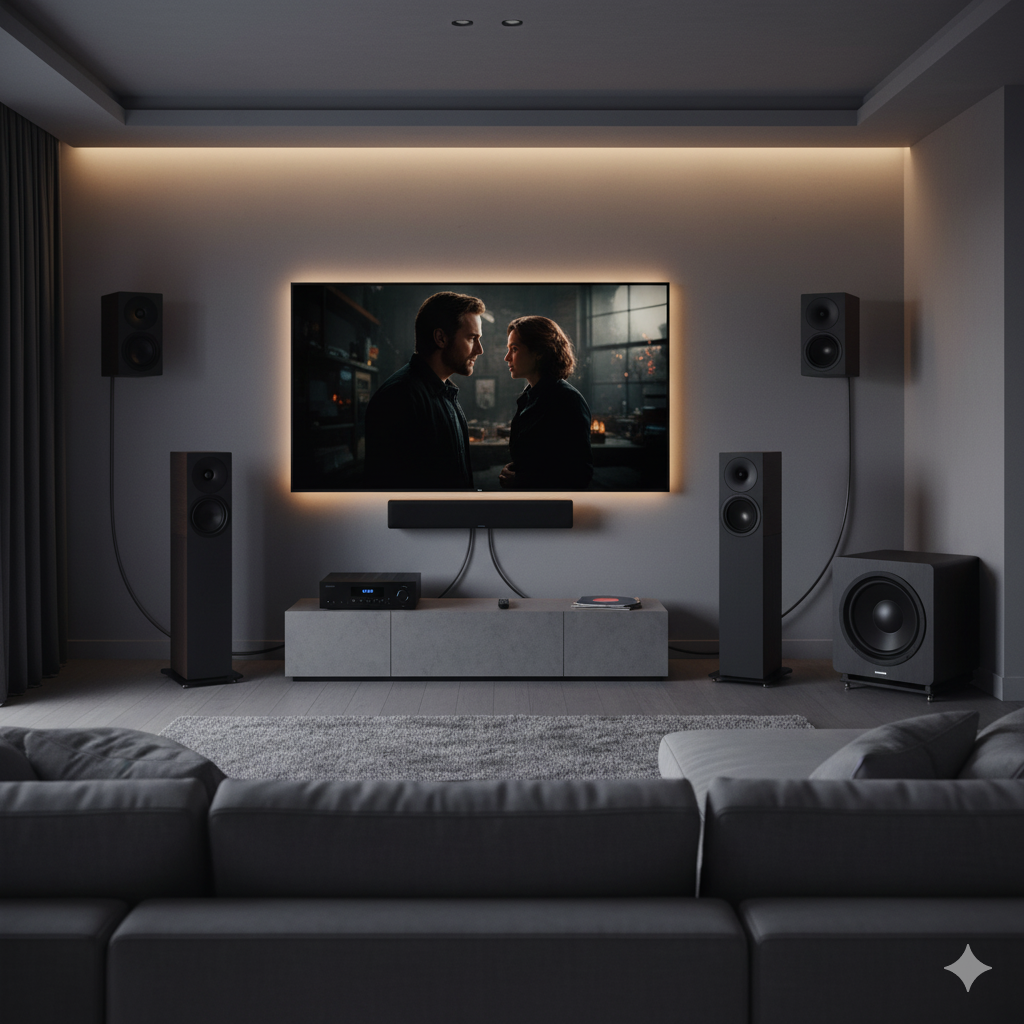
Immersive Sound Engineering: Inside a 5.1 Home Theater System Factory
The Growing Demand for True Cinematic Sound
In the modern entertainment era, audiences expect theater-quality sound at home—deep bass, clear dialogue, and precise directional effects. Yet, many entry-level audio systems fail to recreate spatial accuracy or maintain tonal consistency between channels. The challenge lies not only in power but also in synchronization across five satellites and one subwoofer.
Professional 5.1 home theater system factories like Audfine have redefined this process by integrating acoustic modeling, multi-channel amplification, and DSP control into a unified production pipeline. The result is a balance of immersive sound and manufacturing precision that meets the expectations of both audiophiles and OEM clients.
The Acoustic Principles Behind Surround System Precision
Traditional 5.1 configurations relied on manual tuning and analog amplifiers, which often caused phase mismatch and uneven sound distribution. Each speaker behaved independently, making calibration tedious.
Today’s factories apply digital acoustic mapping and phase-coherent amplification to maintain identical delay timing across all five channels. The subwoofer, meanwhile, is synchronized through DSP to deliver low frequencies that complement rather than overpower the satellites.
Core engineering principles include:
-
Channel Separation: ensuring each driver receives a dedicated, filtered signal.
-
Phase Alignment: correcting delays caused by different cable lengths and cabinet positions.
-
Frequency Smoothing: using digital EQ curves to flatten the overall response curve for consistent tonality.
Through simulation platforms and automated testing, manufacturers can now achieve surround sound accuracy previously limited to high-end professional systems.
Manufacturing Evolution: From Manual Tuning to Digital Coordination
| Process Stage | Conventional Production | Modern 5.1 System Factory |
|---|---|---|
| Amplifier Design | Analog, heat-heavy circuits | Class-D multi-channel modules with low distortion |
| Channel Calibration | Manual measurement | DSP auto-sync with millisecond precision |
| Cabinet Material | Generic wood board | Acoustic MDF and ABS composites |
| Quality Testing | Human hearing checks | Automated frequency and phase response sweep |
| Integration | Separate sourcing | Full in-house integration with QC traceability |
This shift from analog simplicity to digital integration reduces variance, improves reliability, and cuts setup time for end-users. Each system leaving the line undergoes channel delay alignment testing and THD+N verification, ensuring cinematic accuracy straight out of the box.
What Drives the Value of a Modern 5.1 Audio Factory
1. Multi-Channel Amplifier Synchronization
Each amplifier channel is calibrated using DSP to achieve balanced power output, eliminating the “dominant center” issue common in older systems.
2. Intelligent Subwoofer Management
Adaptive crossover technology adjusts low-frequency response dynamically, delivering cleaner bass transitions across various volume levels.
3. Thermal and Energy Efficiency
Class-D amplifiers reduce power loss by over 30%, minimizing heat and extending the lifespan of internal components.
4. Modular Cabinet Design
Standardized satellite enclosures allow scalable production while maintaining acoustic isolation between drivers.
5. Consistency in Global Production
Automation ensures identical acoustic profiles for OEM clients worldwide, supporting CE, FCC, and RoHS compliance in every batch.
Real-World Applications: From Living Rooms to Commercial Venues
The 5.1 system remains the foundation of home cinemas, but its versatility extends far beyond.
-
Residential use: Premium home entertainment setups and smart TV integration.
-
Corporate environments: Boardrooms and immersive presentation systems.
-
Hospitality: Boutique cinemas and themed spaces requiring distributed sound.
-
Educational institutions: Multimedia classrooms and auditoriums with surround playback.
In a recent project, Audfine partnered with a South American brand to supply an integrated 5.1 system for compact theaters. By combining active Class-D amplifiers with tuned wooden enclosures, the system achieved a 35% improvement in spatial imaging and 20% higher energy efficiency compared to the client’s previous model.
Technical and Procurement Guidance for Buyers
-
Power Allocation: Aim for 80–120 W RMS per channel in residential systems; larger venues may need 200 W+.
-
Material Considerations: MDF remains ideal for acoustic damping, while ABS offers durability and lighter shipping weight.
-
DSP Integration: Ensure firmware supports customizable EQ and delay presets for varied room sizes.
-
Cable Management: Opt for oxygen-free copper wiring to reduce resistance and maintain signal integrity.
-
Testing Before Deployment: Conduct pink noise and delay tests to confirm correct spatial positioning.
These practices help importers, integrators, and OEM clients maintain consistent system quality across deployments.
Common Technical Questions
How does a 5.1 system differ from a 7.1 or Atmos setup?
5.1 systems balance immersion and cost, while 7.1 and Atmos add height channels for vertical spatial detail, requiring more complex room calibration.
Can the DSP automatically adjust for different room sizes?
Yes. Modern DSP platforms use adaptive delay and EQ presets to match room dimensions and acoustic reflections.
What’s the standard OEM order size for custom 5.1 systems?
The minimum order quantity (MOQ) typically starts at 1000 sets, supporting cost-effective customization in amplifier tuning and cabinet finishes.
Does Audfine offer branding and acoustic customization?
Yes. Audfine provides private-label production, allowing brands to define their unique acoustic signatures and industrial design.
Building Immersive Sound Through Intelligent Manufacturing
The success of a 5.1 system depends on synergy—between engineering precision, digital control, and acoustic craftsmanship. Modern factories like Audfine combine simulation-driven design with consistent manufacturing discipline to achieve truly cinematic sound experiences.
For brands and distributors seeking to develop high-performance home theater systems with professional-grade calibration, Audfine provides full-cycle OEM services—from design modeling to global delivery.
Learn more on Audfine’s homepage or connect with our technical team via the contact page to discuss project specifications and collaboration opportunities.