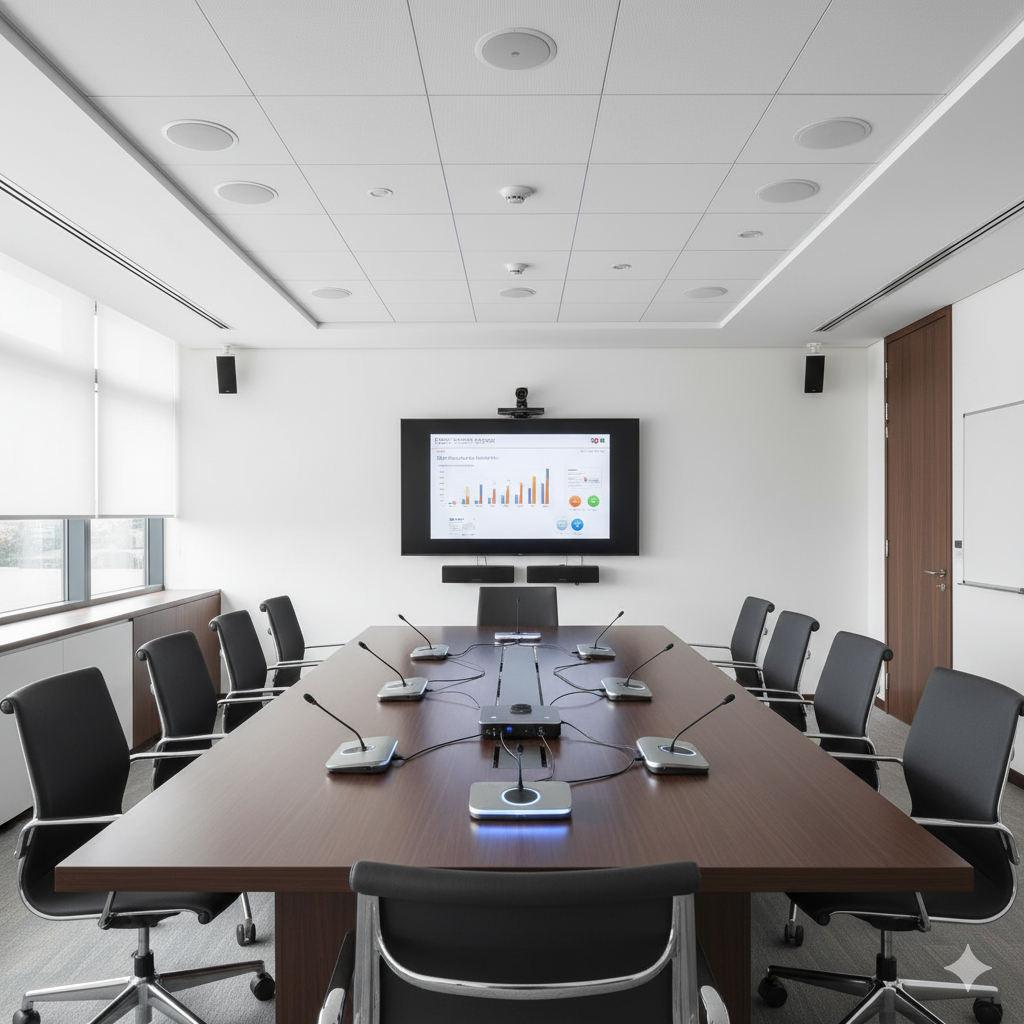
Precision and Clarity: Inside a Conference Speaker System Manufacturer’s Acoustic Design
The Hidden Challenge of Modern Conference Audio
In an era where remote collaboration and hybrid meetings have become the norm, clarity has become the most valuable attribute of communication. Yet, many conference rooms still face persistent issues—uneven voice projection, echo feedback, and unclear speech pickup. These flaws not only disrupt meetings but also reduce professional efficiency.
A modern conference speaker system manufacturer must now engineer beyond loudness. The goal is intelligibility—ensuring that every participant, whether in the front row or joining online, hears speech with equal precision. Factories like Audfine address this challenge through acoustic modeling, DSP tuning, and intelligent network control systems that adapt to real-world environments.
Engineering Logic Behind Conference Speaker Acoustics
Traditional conference setups relied on wall-mounted speakers or ceiling units with fixed EQ presets. Such systems struggled with reflections from glass, metal, and hard surfaces—common in modern office design.
Current systems integrate DSP voice algorithms, directional array speakers, and beamforming microphones that dynamically adjust to room acoustics. Key technologies include:
-
Adaptive equalization to counter reverberation and echo.
-
Time alignment across distributed speakers to maintain phase coherence.
-
Dynamic range compression to stabilize volume between speakers and participants.
-
Feedback suppression to eliminate microphone interference in open-space layouts.
Through acoustic simulation tools, manufacturers predict how frequencies interact within a given room geometry, enabling pre-calibrated tuning before installation even begins.
From Basic Sound Systems to Intelligent Acoustic Networks
| Feature Focus | Traditional Conference Setup | Modern Conference Speaker System Manufacturer Approach |
|---|---|---|
| Signal Processing | Manual EQ presets | DSP-based auto-calibration |
| Speaker Design | Single-direction wall mount | Line-array or ceiling-integrated architecture |
| Microphone Coordination | Independent inputs | Network-synced beamforming systems |
| Control Interface | Analog mixer | IP-based remote configuration |
| Acoustic Management | Fixed coverage | Adaptive feedback and phase alignment |
Unlike outdated systems, digital-driven factories like Audfine employ networked DSP cores to synchronize all microphones and speaker channels. This ensures consistent delay timing and eliminates the “audio drop” effect common in hybrid meetings.
Core Innovations That Define Modern Conference Audio
1. Directional Sound Coverage
Advanced column or array speakers distribute sound evenly across the room, avoiding acoustic shadows and hotspots.
2. DSP-Driven Speech Optimization
Speech-specific EQ algorithms enhance vocal clarity while minimizing background noise, improving speech intelligibility by up to 40%.
3. Modular Installation Flexibility
Ceiling, wall, or table-integrated configurations adapt easily to existing architecture without affecting room aesthetics.
4. Energy and Power Efficiency
Low-voltage amplifier modules and standby automation reduce energy consumption by 20–30%, ideal for corporate or educational facilities.
5. Long-Term Maintenance Stability
System monitoring software allows real-time status tracking and firmware updates across multiple rooms, reducing on-site maintenance costs.
Applications Across Professional and Hybrid Spaces
The conference audio industry has expanded far beyond traditional boardrooms.
-
Corporate headquarters: Seamless communication for hybrid meetings with global teams.
-
Universities and lecture halls: Equal sound distribution for large classrooms and auditoriums.
-
Government institutions: Secure and interference-free communication systems for assemblies.
-
Hotels and convention centers: Portable and scalable PA systems for event management.
-
Online broadcasting rooms: Integrated microphones and DSP control for consistent speech clarity.
A recent Audfine project involved upgrading the sound systems in 50 meeting rooms for a multinational client. By implementing network-synced speakers and adaptive DSP tuning, the client achieved a 45% improvement in vocal clarity and reduced setup time for each meeting by half.
Practical Guidance for Integrators and Buyers
-
Prioritize room-specific calibration: Every conference environment differs in volume and material; pre-modeling with DSP software ensures balanced output.
-
Choose distributed speaker arrays: Even coverage prevents participants in rear sections from losing clarity.
-
Verify microphone-synchronization protocols: Networked systems reduce feedback loops and latency issues.
-
Consider hybrid compatibility: Systems supporting USB, Dante, or PoE+ streamline integration with video conferencing platforms.
-
Plan for firmware scalability: Ensure that control units allow remote software updates for long-term reliability.
Common Questions from System Designers
How do conference speaker systems differ from standard PA setups?
Conference systems focus on vocal clarity and controlled coverage, while PA systems prioritize wide-area volume projection.
Can DSP modules automatically adapt to different meeting sizes?
Yes. Intelligent DSP controllers adjust EQ and delay settings in real time based on microphone feedback and occupancy sensors.
What customization options are available for OEM clients?
Factories like Audfine provide cabinet design, amplifier tuning, branding finishes, and software interface customization.
What is the typical MOQ for custom production?
For OEM conference systems, the minimum order quantity generally starts at 500–1000 units, depending on integration complexity.
Building Reliable Communication Through Acoustic Intelligence
Conference sound is no longer a matter of loudness—it’s a matter of precision, control, and consistency. Through adaptive DSP, modular enclosures, and intelligent signal networks, manufacturers like Audfine deliver systems that empower effective communication in every environment.
For audio brands, system integrators, and corporate clients seeking to upgrade or develop next-generation conference audio solutions, Audfine provides end-to-end OEM support—from acoustic modeling to final system calibration.
Learn more about our integrated audio capabilities at Audfine’s homepage or connect directly with our engineering specialists through the contact page.