Understanding the Horn Tweeter and Its Role in High-Fidelity Audio
A Horn Tweeter is a vital component in audio systems, designed to efficiently reproduce high-frequency sounds with remarkable clarity and power. Often paired with compression drivers, it directs sound waves through a horn-shaped structure to amplify output without requiring excessive power. If you're setting up a pro audio system or upgrading your home setup, selecting the right Horn Tweeter can transform your listening experience. In this guide, we'll explore how to choose, install, and optimize a Horn Tweeter like the innovative DE400 model, ensuring you achieve professional-grade sound reproduction.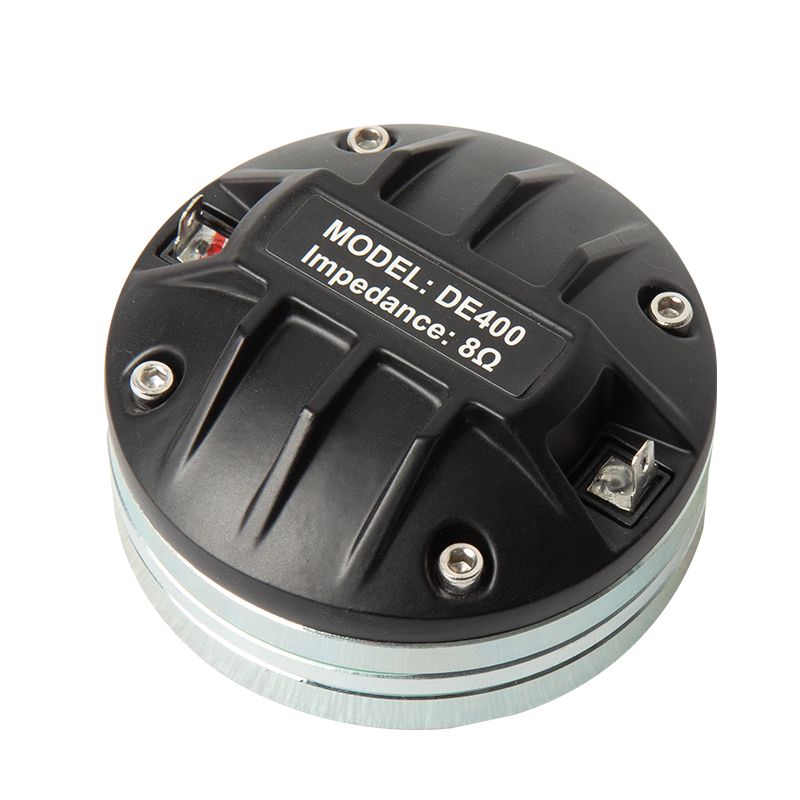
Selecting the Ideal Compression Driver Tweeter for Your Needs
When choosing a Compression Driver Tweeter, start by assessing your audio environment. For professional applications, opt for models with an 8-ohm impedance like the DE400, which integrates seamlessly with amplifiers and ensures efficient power handling. Consider the frequency response: a good Compression Driver Tweeter should handle highs from 1kHz to 20kHz with minimal distortion. The DE400 excels here, crafted from durable metal with a sleek black finish and metallic ring for optimal thermal dissipation. Evaluate build quality—look for lightweight yet robust construction to minimize vibrations. For home theaters or studios, prioritize versatility; the DE400's design supports both immersive setups and high-demand environments. Test compatibility by matching sensitivity ratings (around 100dB for the DE400) to your speakers. Avoid overpaying for unnecessary features; focus on clarity and reliability. By following these steps, you'll select a Compression Driver Tweeter that enhances every note.
Installing a Pro Audio Tweeter Speaker Step by Step
Installation of a Pro Audio Tweeter Speaker requires precision to avoid damaging components. Begin by gathering tools: a screwdriver set, wire strippers, and soldering iron if needed. Disconnect power sources for safety. Mount the tweeter in your enclosure, using the DE400's bolt holes for secure fastening—its compact design fits most cabinets easily. Connect wires to the 8-ohm terminals, ensuring polarity matches to prevent phase issues. For a Horn Tweeter like the DE400, align the horn throat with your midrange drivers for smooth crossover at 1.5kHz. Seal any gaps with acoustic foam to reduce resonances. Power on and test with a frequency sweep app to verify smooth response. If integrating into a PA system, calibrate levels to balance with woofers. This process, done correctly, ensures the Pro Audio Tweeter Speaker delivers crisp, distortion-free highs. For stage use, secure mounting prevents vibrations during performances.
Optimizing a High-Frequency Speaker for Stage Performances
To get the best from a High-Frequency Speaker for Stage, fine-tune your setup post-installation. Use a DSP processor to adjust crossover points, directing highs above 2kHz solely to the tweeter. The DE400's efficient horn design amplifies output, ideal for covering large venues without feedback. Position the High-Frequency Speaker for Stage at ear level, angled toward the audience for even dispersion. In live settings, pair it with a quality mixer to control EQ, boosting presence frequencies around 5kHz for vocal clarity. Monitor for overheating during long sets—the DE400's thermal features handle this well. For outdoor stages, protect against weather with covers. Regularly inspect connections to maintain reliability. This optimization turns a standard High-Frequency Speaker for Stage into a powerhouse, ensuring audiences hear every detail with stunning realism.
Integrating a Studio High-Frequency Driver for Professional Recording
In studio environments, a Studio High-Frequency Driver demands meticulous integration for accurate monitoring. Choose one like the DE400 for its low-distortion profile, essential for critical listening. Install in nearfield monitors, ensuring the horn doesn't color the sound unnaturally. Set crossover slopes at 24dB/octave to blend seamlessly with mids. Calibrate room acoustics using REW software to identify peaks; dampen reflections around the Studio High-Frequency Driver. For mixing, A/B test with reference tracks to verify flat response up to 20kHz. The DE400's precision engineering minimizes phase shifts, preserving transients. Upgrade crossovers if needed for better integration. This approach elevates your studio's fidelity, making the Studio High-Frequency Driver indispensable for producers seeking broadcast-quality results.
By following this how-to guide, you'll harness the power of a Horn Tweeter and its variants to create an audio system that's both powerful and precise. Whether for stage, studio, or home, components like the DE400 deliver exceptional performance, durability, and clarity, elevating every sound to new heights. Invest time in selection and setup for audio excellence that lasts.