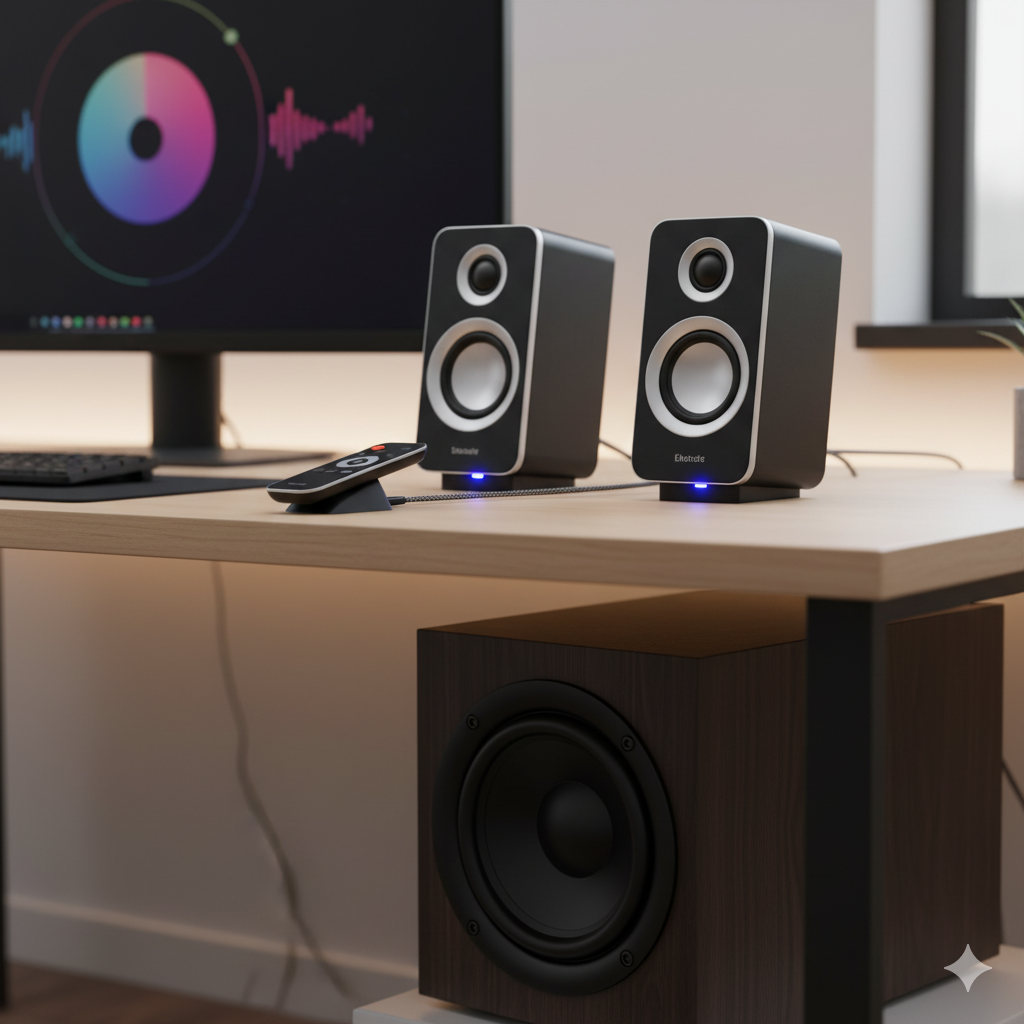
How a Multimedia Speaker Manufacturer Powers Modern Audio Integration
Digital Complexity Meets Everyday Listening
In the modern multimedia era, users demand more than loudness—they expect immersive sound across devices, from laptops and gaming consoles to smart TVs and conference systems. Yet behind this convenience lies a major challenge: how to maintain consistent acoustic performance across multiple input formats and compact enclosures.
Industry data from the Audio Engineering Society (AES) indicates that over 70% of consumer multimedia speakers lose signal integrity when switching between analog and USB digital sources. This inconsistency drives professional multimedia speaker manufacturers to rethink circuit design, amplifier control, and cabinet acoustics.
This article unpacks how today’s producers blend electronics, acoustic science, and manufacturing precision to redefine multimedia audio performance.
Engineering Logic Behind Multimedia Sound Systems
Traditional multimedia speakers were built for affordability—simple amplifiers, limited frequency control, and low-cost plastic housings. Such systems worked, but they lacked warmth, detail, and dynamic stability.
Modern manufacturers have moved toward integrated Class-D amplifiers, DSP-based signal correction, and hybrid enclosure designs that reduce vibration and distortion.
These technologies work together:
-
Digital crossovers optimize frequency handoff between tweeters and woofers.
-
Active enclosure damping minimizes resonance and improves transient response.
-
Intelligent input modules allow seamless switching between AUX, Bluetooth, USB, and optical ports.
With these updates, multimedia speakers are no longer just “computer accessories”—they’re full-spectrum, intelligent sound systems built for multi-platform integration.
Rethinking Manufacturing Standards: From Entry-Level to Engineered Performance
| Component Focus | Old-Generation Multimedia Speaker | Modern Multimedia Speaker Manufacturer Approach |
|---|---|---|
| Amplification | Basic analog circuit | Class-D with DSP correction |
| Material Quality | Thin plastic housing | Acoustic-grade ABS or MDF enclosure |
| Signal Handling | Single analog input | Multi-input: AUX, Bluetooth, USB, optical |
| Frequency Balance | Fixed passive crossover | Adaptive digital tuning |
| Quality Control | Manual audio check | Automated sweep & distortion test |
Unlike low-end consumer systems, new-generation producers design for signal fidelity and power efficiency. With automated testing, each speaker maintains consistent response across devices and platforms, ensuring no loss between gaming, film, or music playback.
Building Performance Through Design Intelligence
-
Integrated Electronics for Simplicity
Built-in amplification reduces external interference and enables cleaner signal flow from source to output. -
Optimized Acoustic Geometry
Internal volume and port placement are simulated to enhance airflow, achieving fuller bass in smaller enclosures. -
Universal Input Compatibility
Multi-channel receivers and USB interfaces allow easy setup across desktops, TVs, and projectors. -
Smart Power Management
Energy-efficient amplifiers minimize heat while maintaining stable voltage supply, extending circuit life. -
Quality Validation at Scale
Automated frequency response matching ensures tonal consistency across every production batch.
Audfine’s engineering teams apply these design principles through CAD modeling, acoustic simulation, and cross-platform testing, guaranteeing that each system performs equally well in both professional and home entertainment setups.
Application Scenarios Across Modern Audio Environments
A multimedia speaker today can be found in nearly every digital environment:
-
Home entertainment systems – producing theater-grade audio for TVs or streaming devices.
-
Gaming stations – where low-latency sound cues enhance performance and immersion.
-
Corporate setups – integrating into conference and all-in-one PC systems for balanced voice clarity.
-
Educational tools – enabling clean audio projection for classrooms and e-learning systems.
In a recent OEM case, Audfine partnered with a European brand to upgrade a USB-powered desktop sound system. By integrating modular DSP and dual passive radiators, the final product achieved 35% higher signal-to-noise ratio and 25% wider frequency response, reducing user complaints about distortion at high volume.
Technical Insights for Product Designers and Buyers
-
Choose the right amplifier power: 20–40 W RMS per channel suits most desktop and meeting-room applications; larger environments benefit from 80 W+.
-
Prioritize enclosure material: MDF yields smoother frequency balance; ABS plastic offers lightweight durability.
-
Confirm DSP capability: Look for tunable EQ presets and automatic gain control for varying content types.
-
Optimize cable and connector quality: Poor shielding often causes noise during USB or AUX playback.
-
Plan for certification: CE, FCC, and RoHS compliance remain essential for global market entry.
Questions from OEM Partners and Integrators
How does a multimedia speaker differ from traditional active speakers?
Multimedia systems emphasize connectivity and platform versatility, while active speakers focus mainly on professional sound reproduction.
Can the same design work across USB and Bluetooth sources?
Yes. DSP-based systems automatically equalize source impedance and adjust gain to maintain consistent loudness and clarity.
What are the customization options for OEM projects?
Cabinet size, finish, amplifier module, and connectivity layout can all be adapted to target markets or brand positioning.
How does Audfine ensure reliability across long production runs?
Each batch undergoes impedance scanning, THD+N testing, and thermal cycling to guarantee consistent electrical performance.
Integrating Technology and Partnership for the Next Audio Era
The modern multimedia speaker manufacturer stands at the intersection of audio engineering and digital convenience. Through smart amplification, universal connectivity, and acoustic control, compact systems now deliver both precision and power across devices.
For audio brands, importers, or OEM clients seeking scalable multimedia speaker production, Audfine offers full-chain design and testing capabilities to ensure professional-grade results.
To discover how our engineering process can support your next multimedia audio project, visit Audfine’s homepage or reach the technical team through the contact page for collaboration details and quotations.