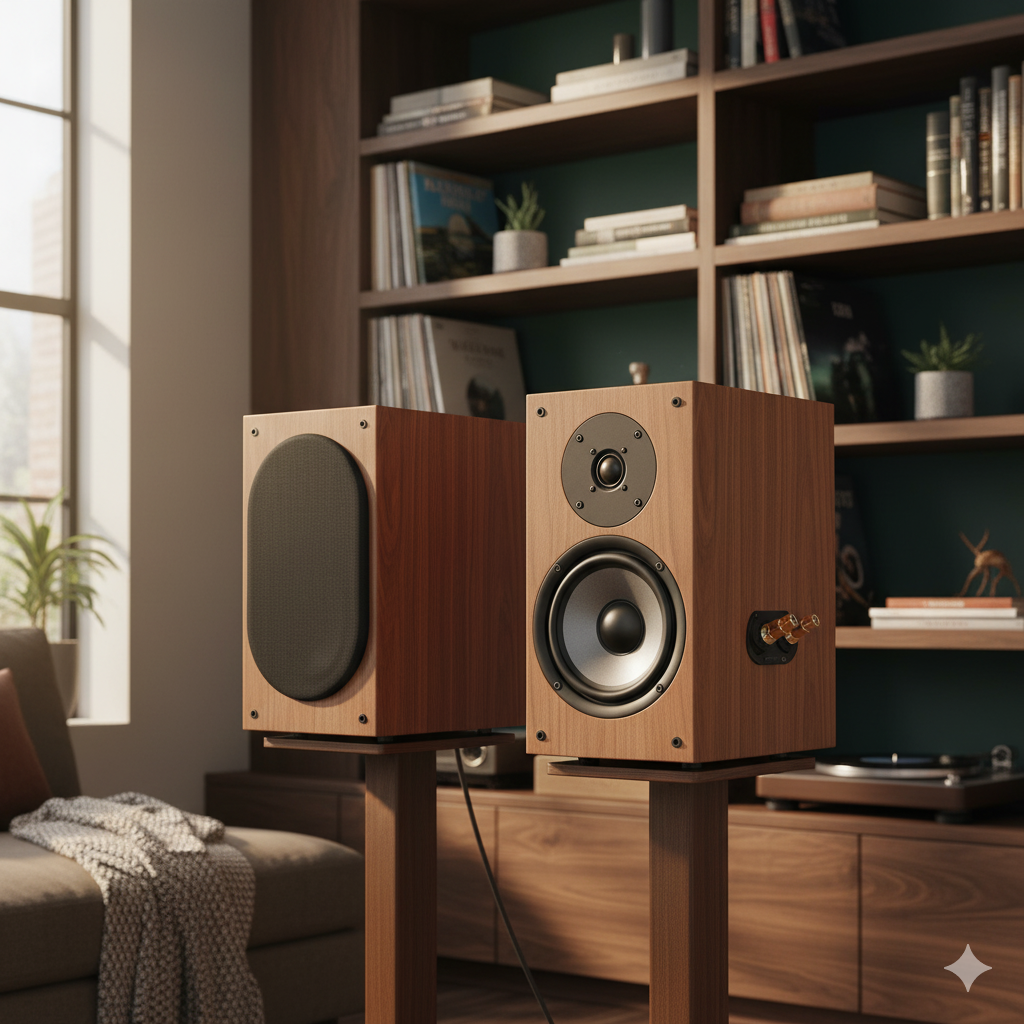
Balancing Size and Sound: Inside the Craft of a Bookshelf Speaker Producer
Compact Form, Big Expectations: The Real Challenge Behind Modern Speaker Design
Across the audio industry, a consistent challenge remains—how to deliver full-bodied sound from a compact frame. Consumers want elegance and clarity in one form, but small cabinets naturally restrict airflow and resonance. According to the Audio Engineering Society (AES), over half of compact speakers show a 6–10 dB drop in the 150 Hz range due to enclosure limitations.
To counter this, today’s bookshelf speaker producers integrate acoustic simulation, precision driver engineering, and DSP calibration, turning compact speakers into efficient sound systems capable of studio-level fidelity.
The Science Guiding Acoustic Precision in Limited Space
Earlier generations of bookshelf speakers relied on basic wooden boxes and analog crossovers. The result was inconsistent frequency balance, particularly in mid-bass performance.
Modern producers take a scientific route: combining multi-layer MDF cabinets, tuned port geometry, and internal damping materials that reduce vibration by up to 30%. When paired with digital signal processing (DSP), these designs allow smaller speakers to replicate low-frequency extension traditionally achievable only in floor-standing systems.
Through advanced modeling tools and adherence to AES and IEC testing standards, companies like Audfine now achieve predictable acoustic outcomes regardless of enclosure size or user environment.
Redefining Production Logic: How Modern Methods Surpass Traditional Builds
| Production Aspect | Conventional Approach | Modern Bookshelf Speaker Production |
|---|---|---|
| Cabinet Structure | Simple MDF box, low rigidity | Layered MDF + acoustic bracing for vibration control |
| Frequency Tuning | Passive network only | DSP and hybrid crossover integration |
| Power Efficiency | 50 W average | 100–150 W with Class-D amplification |
| Calibration | Manual adjustment | Automated frequency response matching |
| Material Quality | Limited damping | Fiber-reinforced acoustic lining |
Unlike conventional designs, today’s bookshelf speaker producer focuses on repeatability and calibrated precision—each unit leaving the line meets identical frequency response tolerance within ±0.5 dB.
Design Intelligence That Translates to Performance and Value
Every component inside a high-end bookshelf speaker contributes to sound stability and lifecycle reliability.
-
Cabinet geometry optimization minimizes internal standing waves, extending usable bass range by approximately 25%.
-
Digital crossover integration enables phase alignment between tweeter and woofer, improving stereo imaging.
-
Component uniformity—from voice coils to magnetic assemblies—guarantees consistent impedance curves across batches.
-
Thermal-efficient Class-D amplification lowers power loss and reduces operating temperatures, extending circuit lifespan.
-
Environment-ready materials, compliant with RoHS and REACH, support sustainable production without compromising acoustic quality.
Real Applications in Use
A European audio brand partnered with Audfine to modernize its compact speaker line aimed at small studios and minimalist homes.
-
Challenge: limited bass depth and tonal imbalance across production batches.
-
Implementation: adoption of Audfine’s modular DSP tuning and fiber-reinforced enclosures.
-
Outcome:
-
30% less harmonic distortion
-
40% broader low-frequency response
-
20% reduction in production time due to automated calibration
This collaboration illustrates how precision manufacturing and system modeling reshape what’s possible for compact loudspeakers.
-
Practical Guidance for Audio Designers and System Buyers
Selecting the right bookshelf configuration requires balancing acoustic goals with spatial and budget constraints.
-
Match power output to room volume—60–80 W suits small spaces, 120 W+ for open-plan studios.
-
Choose driver composition carefully: aluminum domes enhance crispness, silk domes offer warmth.
-
Consider cabinet material based on humidity and resonance control—MDF for damping, aluminum for durability.
-
For OEM projects, verify DSP module compatibility and branding requirements early to streamline certification.
-
Always validate frequency response in semi-anechoic environments before finalizing design approval.
Common Technical Questions in OEM Collaboration
What distinguishes bookshelf speakers from general compact audio systems?
Bookshelf speakers are tuned for near-field accuracy, emphasizing flat response rather than exaggerated bass typical of consumer systems.
How can tuning remain consistent across thousands of units?
Producers employ batch-level calibration using automated sweep analysis and impedance matching during final QC.
Is it possible to customize acoustic targets for regional markets?
Yes. DSP parameters and crossover curves can be localized to match listening preferences or environmental acoustics.
What is the standard OEM order scale?
A typical production cycle begins at 1000 units per model, balancing cost efficiency with tooling and testing accuracy.
Sustaining Quality Through Intelligent Manufacturing Partnerships
The evolution of bookshelf speaker production has transformed compact sound systems into precision-built acoustic tools. Through modular cabinet design, DSP calibration, and automated quality verification, modern producers now achieve the perfect balance between clarity, power, and efficiency.
For brands and OEM partners, choosing a producer like Audfine means more than manufacturing—it means collaborating with a team that understands sound at every engineering stage, from driver design to global delivery.
To explore how Audfine’s technology can elevate your next compact speaker project, visit our homepage or connect directly with our engineering team via the contact page for consultation and OEM cooperation details.