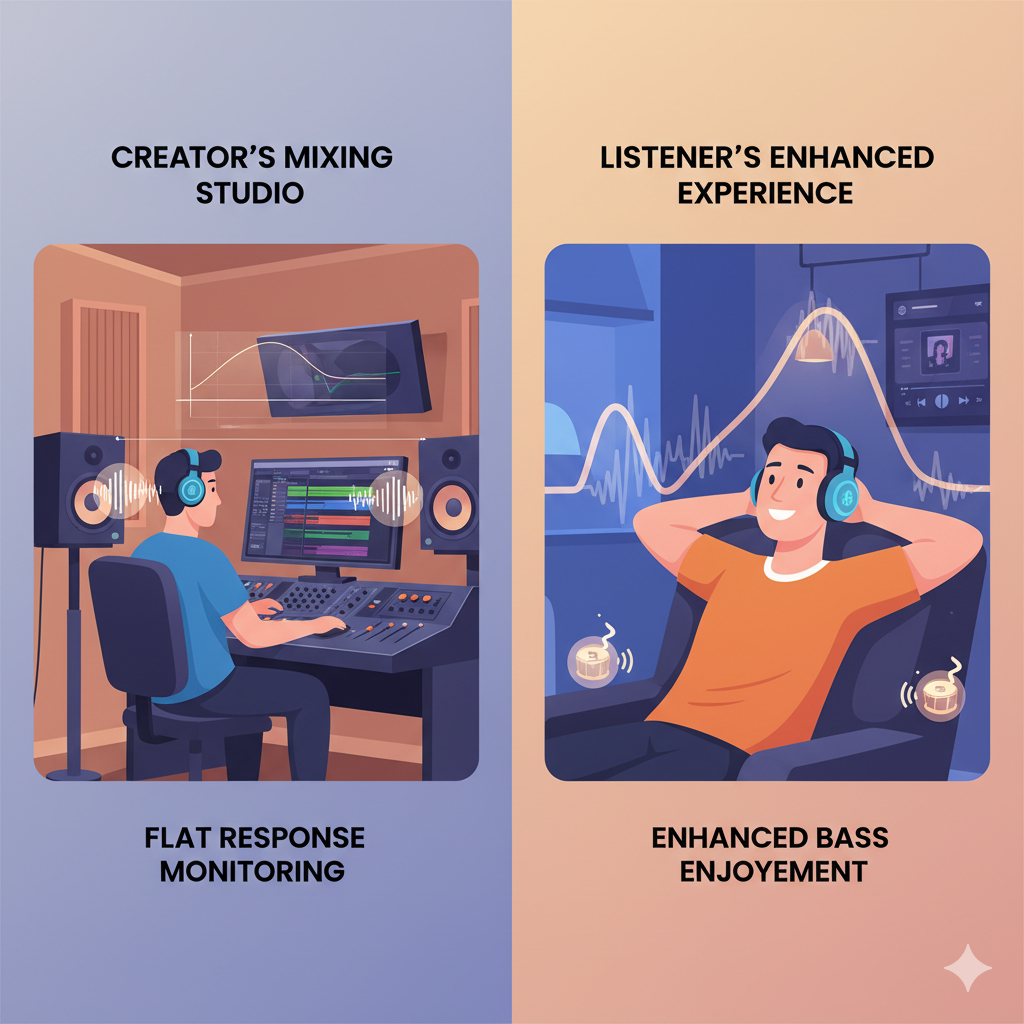
Flat Response vs. Enhanced Bass: What Works Best for Home Studio Creators
The Mixing Dilemma Facing Home Studio Producers
For many home studio creators, the biggest challenge isn’t writing melodies or programming beats—it’s trusting what they hear. Headphones and monitors designed for casual listening often exaggerate bass or treble, which can make a track sound “powerful” in the moment but unbalanced when played on other systems. On the other hand, gear with flat response provides accuracy but may feel uninspiring during creative sessions. This trade-off raises a central question: should home studio producers prioritize flat response or enhanced bass in their monitoring equipment?
Flat Response: Accuracy Above All
Flat response headphones and monitors are engineered to reproduce audio as neutrally as possible, without boosting or cutting specific frequencies. For creators, this means:
-
True-to-source sound – Every layer of the mix, from kick drum to vocal reverb, is heard in its natural state.
-
Reliable translation – Mixes crafted on flat-response gear will sound consistent across car stereos, streaming platforms, and PA systems.
-
Critical editing – Subtle imperfections like plosive sounds or reverb tails are easier to catch and fix.
Flat response is particularly useful for mixing and mastering, where precision is essential to achieving professional results.
Enhanced Bass: Energy for Creativity
By contrast, enhanced bass headphones and monitors are designed to emphasize the low end. While not always accurate for mixing, they have their own advantages for creators:
-
Inspiration during writing – Heavy drops and beats feel more energetic, helping maintain creative flow.
-
Better reference for consumer playback – Since many listeners use bass-boosted devices, enhanced bass provides insight into how tracks may sound to end users.
-
Motivation in practice – Producers often find long sessions more enjoyable when music feels powerful and immersive.
Enhanced bass gear has its place in idea generation and for checking how music will “hit” in real-world playback situations.
Technical Considerations for Home Studio Choices
When deciding between flat response and enhanced bass, creators should weigh several key factors:
| Factor | Flat Response Benefit | Enhanced Bass Benefit |
|---|---|---|
| Mixing Accuracy | Neutral balance ensures professional results | Exaggeration may mislead EQ decisions |
| Creative Inspiration | May sound clinical during songwriting | Adds energy and excitement to sessions |
| Workflow Stage | Ideal for mixing/mastering | Useful for drafting and idea testing |
| Listener Reference | Ensures cross-system consistency | Simulates how casual listeners hear |
Application Scenarios in Home Studios
Different production stages highlight the unique value of each approach:
-
Songwriting and Sound Design – Enhanced bass can make long creative sessions more engaging and inspire new ideas.
-
Critical Mixing – Flat response reveals flaws and ensures the final balance translates across playback systems.
-
Final Playback Check – Switching between flat and bass-enhanced headphones provides a complete perspective before release.
A hybrid workflow—using both styles of gear—often delivers the best results.
Buyer Insights: Matching Gear to Workflows
Not every home studio has the same priorities. Creators should align equipment with their main goals:
-
Beginner Producers – A balanced entry-level flat-response model ensures mixes don’t fall apart outside the studio.
-
Electronic Music Creators – Enhanced bass headphones help test drops and sub-heavy sections in real-world scenarios.
-
Singer-Songwriters – Flat response models emphasize vocal clarity, aiding in accurate layering and editing.
-
Hybrid Producers – Owning both flat response and bass-enhanced gear allows switching perspectives seamlessly.
FAQ: Common Concerns from Home Studio Creators
Q1: Can I mix on enhanced bass headphones?
Not reliably. They can exaggerate lows, but using them alongside flat-response gear for reference is effective.
Q2: Do I need two pairs of headphones for home studio use?
Not strictly, but having both offers flexibility—flat response for accuracy, enhanced bass for inspiration and playback checks.
Q3: What should I prioritize if budget is limited?
Flat response should come first. Accuracy ensures your mixes will sound good everywhere, even if bass feels less “exciting.”
Why the Right Choice Matters for Every Creator
Choosing between flat response and enhanced bass is not about one being better—it’s about what fits your creative workflow. Flat response delivers trust and accuracy, ensuring your work translates everywhere. Enhanced bass brings energy and motivation, keeping creativity alive during long sessions.
At Audfine, we design solutions that balance both needs, offering precision when it’s required and power when it’s desired. By combining technical engineering with user-centered design, our headphones support home studio creators at every stage—from inspiration to professional release.
Ready to refine your sound? Explore more on our Homepage or connect directly via Contact Us.