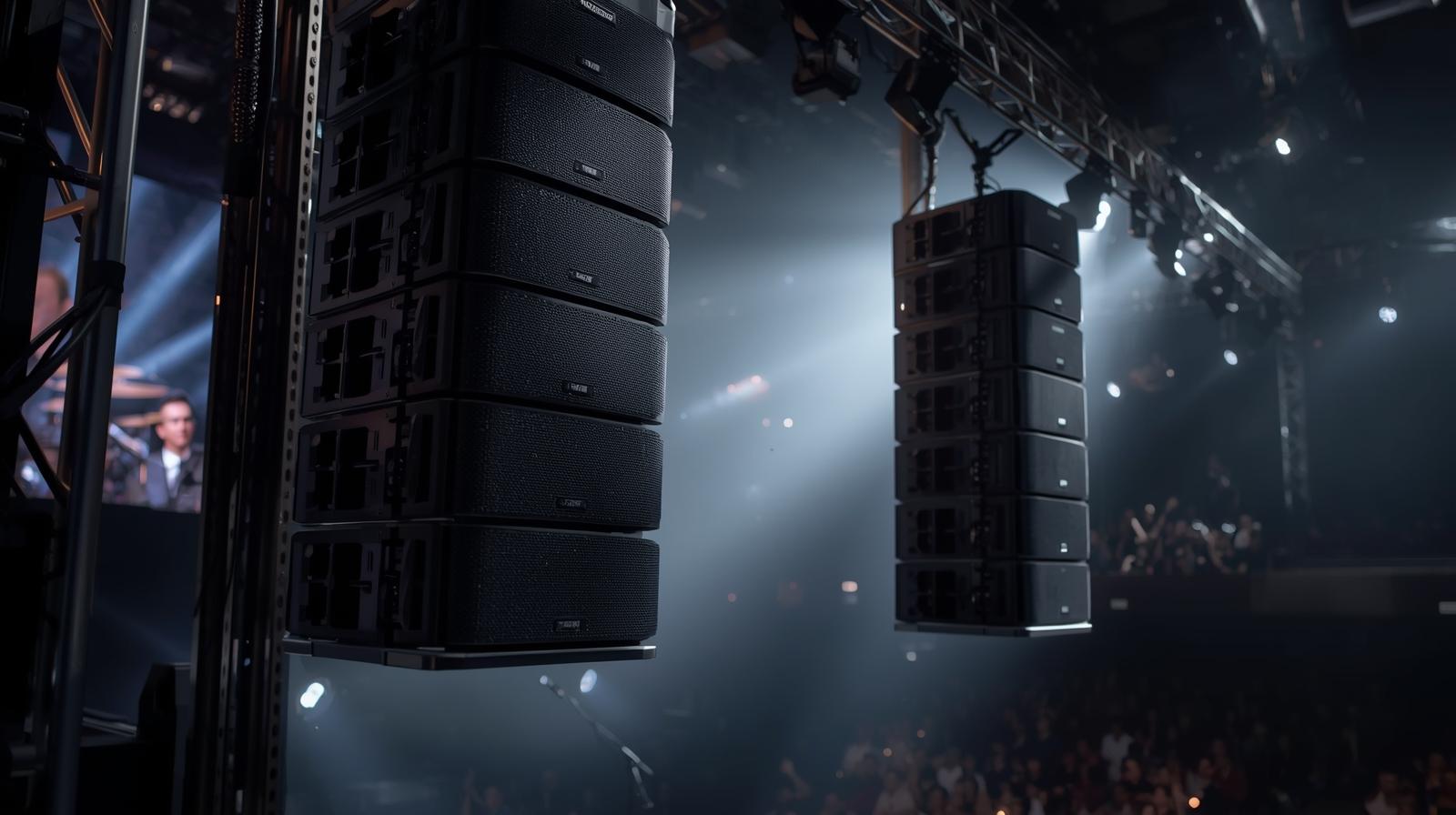
Shaping the Stage: How Active Line Array Systems Deliver Precision and Power
Why Line Array Systems Became the Backbone of Live Sound
Large-scale events today—from outdoor festivals to corporate presentations—demand more than just volume. They require precision, balance, and even coverage across wide audiences. Traditional PA setups often struggled with uneven sound distribution: the front row overwhelmed by volume, the back barely hearing a word.
That’s where the active line array system comes in. By combining modular speaker design, built-in amplification, and intelligent DSP processing, it has become the professional standard for consistent sound delivery in any venue. Manufacturers like Audfine design these systems to provide controlled projection, minimal distortion, and plug-and-play scalability, ensuring every listener experiences the same clarity—no matter where they stand.
The Acoustic Principle Behind Line Array Precision
Unlike traditional point-source speakers that radiate sound in all directions, line arrays use vertically stacked cabinets to create a coherent wavefront. The result is directional control—sound travels farther and remains consistent in tone and volume.
In an active line array, each module contains its own amplifier and DSP unit. This integration removes the need for bulky external racks and allows each cabinet to manage frequencies, delays, and crossovers autonomously. The DSP ensures that every speaker—whether at the top or bottom of the stack—maintains precise phase alignment, preventing frequency cancellation and boosting clarity over long distances.
Modern systems like those engineered by Audfine employ finite-element acoustic modeling and digital delay compensation, fine-tuning output for venues of all shapes—from open stadiums to compact theaters.
Comparing Traditional and Active Line Array Designs
| Feature | Passive Line Array | Active Line Array System |
|---|---|---|
| Amplification | External amp racks | Built-in Class-D amplifier modules |
| Signal Control | Manual crossover setup | DSP auto-tuned frequency division |
| Setup Time | Requires amplifier matching | Plug-and-play connection |
| Weight and Cabling | Heavy with multi-core cables | Lightweight, single-power-line operation |
| Maintenance | Higher due to external gear | Simplified modular replacement |
This evolution reflects a clear shift from analog dependence to digital precision. Engineers now deploy fewer components while achieving greater control and reliability in live environments.
Why Active Line Arrays Redefine Professional Sound
1. Precision Coverage
Vertical stacking combined with DSP-driven wave control ensures even sound pressure across every audience area, minimizing volume drops at a distance.
2. Efficiency and Portability
Integrated amplifiers and lightweight neodymium drivers allow fast setup, less transport weight, and lower power consumption.
3. Real-Time Acoustic Adjustment
With on-board DSP, engineers can modify EQ, delay, and limiter settings directly from a digital console or tablet—ideal for multi-venue tours.
4. Reliable Protection and Longevity
Thermal monitoring, limiter circuits, and clip protection prevent overload during long shows, extending system lifespan.
5. Scalable Design
Each cabinet operates as an independent unit, allowing easy expansion from a two-box setup to a full concert rig without reconfiguration.
Where Active Line Arrays Make the Difference
Active line array systems have become the workhorse of modern sound reinforcement, applied far beyond music concerts.
-
Outdoor concerts and festivals – delivering consistent tone across thousands of listeners.
-
Corporate and government events – ensuring speech intelligibility in large open spaces.
-
Theaters and houses of worship – maintaining dynamic range with minimal reverberation.
-
Touring productions – offering fast setup and breakdown with minimal technical dependency.
When Audfine supplied an active line array solution for a regional touring company, engineers reported 40% faster setup times and a 30% improvement in mid-range clarity compared to their previous passive systems—all while reducing transport weight by nearly half.
Practical Considerations When Choosing an Active Line Array
-
Venue Size and Geometry: Choose cabinet quantity and horn dispersion based on vertical and horizontal coverage needs.
-
Power Output: For mid-sized events, 500–800 W RMS per cabinet provides ample headroom.
-
Rigging Hardware: Look for certified fly-frame and quick-lock mechanisms for safe, efficient assembly.
-
DSP Control Interface: Systems with remote software allow fine-tuning without physical adjustment.
-
Component Matching: Ensure all modules share identical DSP presets to maintain phase coherence.
These details help buyers and integrators achieve predictable performance with fewer variables during installation.
Common Technical Questions
Can active line arrays be mixed with passive speakers?
Technically yes, but for consistent timing and EQ control, it’s best to use a unified active system.
Do active systems require separate amplifiers?
No. Each cabinet houses its own amplifier channel, optimized for its driver combination.
How are these systems controlled on-site?
Most include network interfaces or proprietary apps that allow engineers to adjust EQ, gain, and delay remotely.
Is customization available for OEM projects?
Audfine offers complete OEM services—from cabinet design and amplifier tuning to branding and certification—tailored for different market requirements.
Elevating Live Sound Through Intelligent Design
The modern stage demands more than power—it demands precision, reliability, and adaptability. Active line array systems deliver all three, combining acoustic science with integrated control for a truly balanced sound experience.
For event organizers, touring companies, or audio brands seeking high-performance modular sound systems, Audfine provides full-cycle OEM manufacturing—from acoustic modeling to production and global logistics.
Discover more about our professional sound solutions at Audfine’s homepage or contact our engineering team via the contact page to discuss your next project.