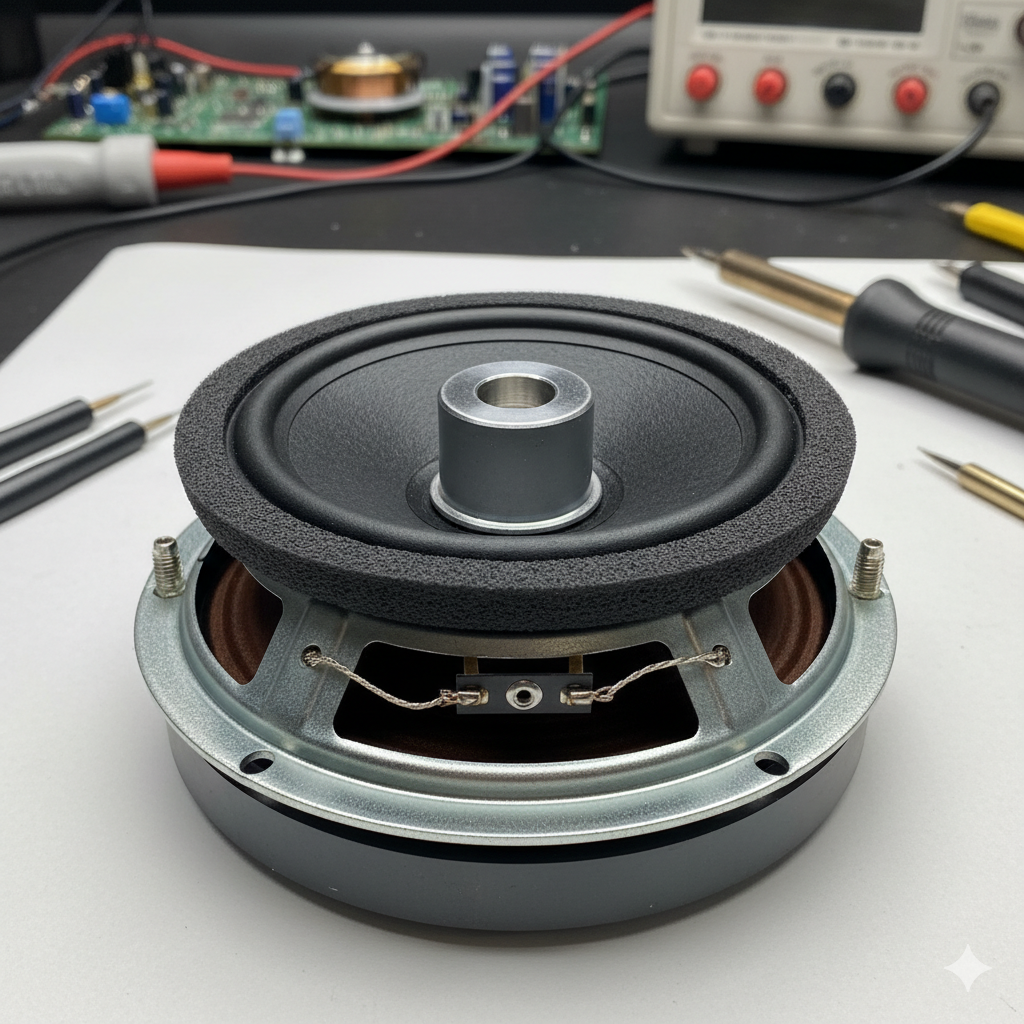
Material Matters: How Cone and Dome Choices Define Speaker Driver Performance
Identifying the Challenge: Why Material Selection Shapes Sound Identity
In loudspeaker design, the driver remains the most defining element of overall sound quality. Yet even within professional manufacturing, material selection for cones and domes is often underappreciated. While electrical components can be digitally tuned, mechanical behavior—stiffness, mass, and internal damping—depends on the physical properties of these materials.
The central challenge for every speaker driver factory is to balance these attributes: achieve high sensitivity without distortion, rigidity without resonance, and longevity without tonal coloration.
The Science of Sound Conversion: How Cones and Domes Function
A speaker driver converts electrical signals into mechanical motion. The cone (for midrange and bass frequencies) and dome (for high-frequency response) act as diaphragms that move air.
-
Cones must be rigid enough to maintain shape under strong motion, preventing breakup at high SPL levels.
-
Domes require lightweight materials with excellent internal damping to maintain linear movement at ultrasonic speeds.
Material stiffness affects accuracy, density influences transient response, and damping determines how vibrations decay—factors directly measurable in frequency and phase curves.
Comparing Common Materials: Strengths and Trade-offs
| Material Type | Characteristics | Acoustic Outcome | Typical Application |
|---|---|---|---|
| Paper Pulp | Lightweight, natural damping | Warm, natural tone with smooth roll-off | Hi-Fi and vintage systems |
| Polypropylene | Flexible, low resonance | Controlled mids but softer transients | Home audio, compact drivers |
| Aluminum Alloy | Rigid and light | Crisp attack, potential for high-frequency ringing | Studio monitors, tweeters |
| Kevlar / Carbon Fiber | High stiffness-to-weight ratio | Detailed imaging, fast transient response | Premium speakers |
| Titanium / Beryllium Domes | Extremely rigid, precise | Extended treble with superior phase alignment | Professional monitors, HF drivers |
There is no universal “best” material. The optimal choice depends on the target frequency range, desired tonal character, and operating environment.
Real-World Application: Matching Material to Acoustic Purpose
In a modern speaker driver factory, material selection begins with acoustic modeling:
-
Home Cinema and Hi-Fi: Paper or composite cones deliver warmth and low fatigue for long listening sessions.
-
Studio Monitors: Aluminum or carbon fiber drivers emphasize precision and speed, ideal for analytical mixing.
-
Outdoor or Touring Systems: Polypropylene and Kevlar resist moisture and mechanical stress, maintaining stability in extreme conditions.
-
Compact Consumer Products: Lightweight polypropylene or treated paper ensures efficiency at smaller driver diameters.
By aligning mechanical design with application, factories ensure both tonal balance and structural reliability over years of use.
Engineering Recommendations: Key Parameters in Material Evaluation
For engineers and acoustic designers, three measurable factors define cone and dome performance:
-
Young’s Modulus (Rigidity): Determines resistance to deformation under force; affects distortion levels.
-
Density: Impacts mass and, consequently, transient response and system sensitivity.
-
Internal Damping Coefficient: Controls how resonances decay; crucial for natural timbre.
A high-performance driver achieves equilibrium among these parameters rather than maximizing one at the cost of another.
Our Manufacturing Advantage: Precision and Material Control at Every Stage
At Audfine, our speaker driver factory integrates mechanical engineering, material science, and acoustic calibration within a single workflow:
-
Material Pairing: Each cone and dome is matched to coil and suspension characteristics through simulation testing.
-
Hybrid Composites: Use of reinforced paper-fiber and carbon-polymer blends for optimal stiffness-to-weight ratio.
-
Acoustic Damping Optimization: Internal coatings and micro-layer bonding reduce harmonic distortion by up to 20%.
-
Comprehensive Validation: Each batch undergoes frequency response scanning, distortion analysis, and environmental stress testing.
This process ensures that our drivers maintain both tonal transparency and mechanical durability, meeting the standards of professional and consumer applications alike.
Final Perspective
In loudspeaker engineering, material choice is the foundation of sound identity. Every diaphragm carries the acoustic fingerprint of its composition—defining warmth, detail, and dynamics. Through precise manufacturing control, modern speaker driver factories have turned material science into an art form, balancing physics and perception in every design.
To explore custom driver solutions or OEM collaboration, visit Audfine Homepage or contact us via Contact Us.